
Detecting Ship-to-Ship Activity in Real Time
When two vessels meet at sea, knowing about it matters
Vessels operate close to one another every day, especially around ports, anchorages, and busy shipping areas.
But there is a significant difference between two vessels simply passing each other and two vessels remaining close together for an extended period.
Ship-to-ship activity can be completely legitimate. Vessels may transfer cargo or fuel, support offshore operations, or exchange personnel.
At the same time, ship-to-ship activity can also be relevant from a safety, security, and compliance perspective. Authorities increasingly highlight STS transfers as something worth monitoring because they may be used to obscure cargo movements or form part of sanctions-evasion activity.
The challenge is therefore not simply to see vessels on a map. It is to identify when vessel behaviour develops into a pattern that requires attention.
What is a ship-to-ship event?
A ship-to-ship event occurs when two vessels remain sufficiently close to each other and display a movement pattern consistent with a meeting at sea.
Such meetings can look very different. Some may last only a short time, while others can continue for hours. The vessels may be nearly stationary, moving slowly together, or drifting while remaining close.
This makes simple proximity alone a poor indicator.
Two vessels passing each other at close range should not necessarily trigger an investigation. Two tankers remaining alongside each other at low speed for several hours in an unexpected location may be far more relevant.
Context and duration are therefore essential.
Why ship-to-ship activity matters
International authorities have placed increasing attention on higher-risk STS activity, particularly in relation to sanctions evasion and so-called shadow or dark fleet operations.
Patterns such as repeated STS transfers, activity in unusual locations, AIS irregularities, or meetings involving sanctioned vessels may justify further investigation.
However, an STS event does not in itself mean that illegal activity is taking place.
It is an indicator.
The value lies in detecting the activity early enough for an operator to assess the vessels involved, their history, location, ownership, sanctions status, and surrounding behaviour.
Detecting the behaviour automatically
Manually identifying ship-to-ship activity is difficult when monitoring large areas or high volumes of vessel traffic.
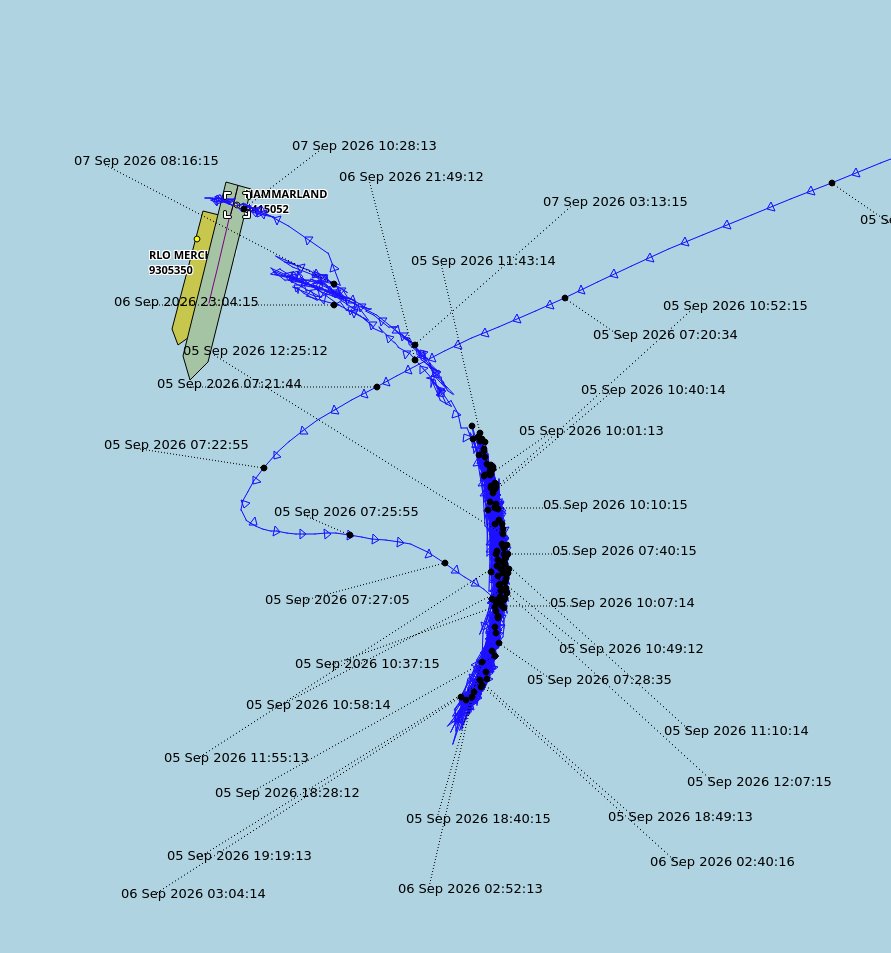
Gatehouse Maritime’s Ship-to-Ship Event Detection continuously monitors vessel behaviour and identifies when two vessels match a predefined ship-to-ship pattern.
Users define the behaviour they want to detect, including how long vessels must display the relevant pattern before an event is triggered.
This helps separate momentary proximity from a more persistent vessel meeting.
For example, an organization may want to identify two vessels remaining close together for a sustained period while operating at low speed.
The system then alerts the operator when that defined behaviour occurs.
Real-world use cases
Monitoring potential sanctions-related activity
STS activity combined with factors such as sanctioned vessels, unusual locations, AIS irregularities, or repeated transfers can be an important indicator.
Detecting the meeting in real time gives analysts a starting point for further investigation.
Monitoring national waters and Exclusive Economic Zones
Maritime authorities cannot manually follow every vessel interaction across large geographical areas.
Automatic STS detection can highlight prolonged vessel meetings inside an EEZ or another defined area and help operators focus on the activity that matters.
Detecting unusual tanker activity
STS transfers are widely used within the tanker industry for legitimate purposes.
However, the location and circumstances matter.
An expected transfer inside a known STS area may require little attention. Two tankers meeting for several hours in an unusual offshore location may justify further investigation.
Supporting maritime security operations
A vessel may appear completely normal when viewed in isolation. Its interaction with another vessel can provide important additional context.
Ship-to-ship detection helps operators move from asking:
Where is this vessel?
to:
What is this vessel doing, and who is it doing it with?
An event is the beginning of the investigation
Ship-to-ship detection should not automatically classify activity as suspicious or illegal.
Instead, it indicates that a defined behaviour has occurred.
Once an event is detected, operators can investigate the vessels involved and combine the event with other information available in Maritime Domain Monitor.
Is one of the vessels sanctioned?
What vessel types are involved?
Who owns or operates them?
Where did they come from, and where are they heading?
Have they previously been involved in similar activity?
Are there AIS gaps or other unusual patterns around the meeting?
Combining behavioural detection with vessel information gives operators the context needed to determine whether an event is routine or requires further action.
Turning vessel movements into actionable events
Modern maritime monitoring requires more than displaying vessel positions on a map.
Ship-to-Ship Event Detection allows users to define the vessel behaviour that matters to their operation and automatically creates an event when those conditions are met.
This helps maritime authorities and operators focus their attention on the vessel interactions that require investigation.
Ship-to-Ship Event Detection is available as part of Gatehouse Maritime’s Event Alerting capabilities in Maritime Domain Monitor.
Authored by

Kim Bøjlund
Kim Bøjlund, Senior Product Manager, Gatehouse Maritime
Other knowledge
Let’s get in touch
Do you want do know more about our solutions?
Our experts are ready to answer any questions you might have and show you how our solutions can benefit your operations.